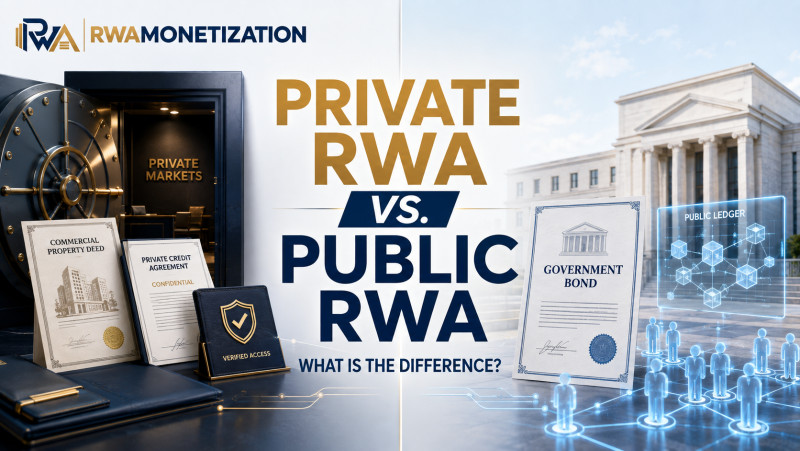
“Private” and “public” can describe different things
The phrases “private RWA” and “public RWA” do not have one universal legal definition. They may refer to the nature of the underlying market, who can access a product, or whether the blockchain network itself is permissioned or open.
These concepts should not be mixed together. A privately offered security could be represented on a public blockchain while transfers remain legally restricted. A government bond—normally associated with a public market—could operate on a permissioned network available only to approved institutions.
What is a private RWA?
A private RWA generally represents an interest or claim that is not broadly offered or traded in a public market. Examples may include private credit, shares in a privately held company, private real-estate funds, infrastructure interests, or invoices.
Private assets often involve negotiated terms, limited disclosure, transfer restrictions, longer holding periods, and less frequent valuation. In some jurisdictions, participation may be limited to eligible, professional, accredited, or qualified investors.
Tokenization can make administration more efficient, but it does not automatically convert a private offering into a public one. The product may still be subject to restrictions on solicitation, resale, investor eligibility, and reporting.
What might be called a public RWA?
The term may describe a tokenized version of a publicly issued or broadly accessible asset, such as a government bond, listed security, regulated fund, or other instrument offered under a public-market framework.
However, accessibility depends on law, product design, intermediaries, and geography. A token visible in a public wallet does not necessarily give every wallet holder the legal right to acquire or transfer it.
Permissioned versus permissionless networks
A permissioned network controls who may validate transactions, operate infrastructure, or hold and transfer assets. A permissionless network generally allows broader participation at the protocol level.
Neither design alone determines whether the underlying asset is private or public. The network is the technical environment; the offering and ownership rights are legal and financial arrangements.
The comparison that matters
QuestionPrivate-market RWAPublic-market RWAAccessOften limited by eligibility and offering rulesPotentially broader, subject to market and jurisdiction rulesDisclosureOften negotiated or limitedUsually more standardized and frequentLiquidityCommonly limitedMay be greater, but never guaranteedValuationOften periodic or model-basedMay benefit from observable market pricesTransferFrequently restrictedMay be more standardized but still regulated
The bottom line
“On a public blockchain” does not mean “publicly investable,” and “tokenized” does not mean “freely transferable.” Readers should identify the underlying asset, offering structure, investor eligibility rules, and authoritative ownership record before drawing conclusions about access.
Tags: Private RWA, Public Markets, Private Markets, Permissioned Blockchain, Public Blockchain, Investor Eligibility, Tokenized Securities